
What to Bring:
- If you have any electronic equipment that needs to be plugged in, you need to bring your own extension cords.
- Make sure you have a logbook of all of your background research, raw data, consent forms, and anything else you did to support your project (this is like a diary of your work on your project).
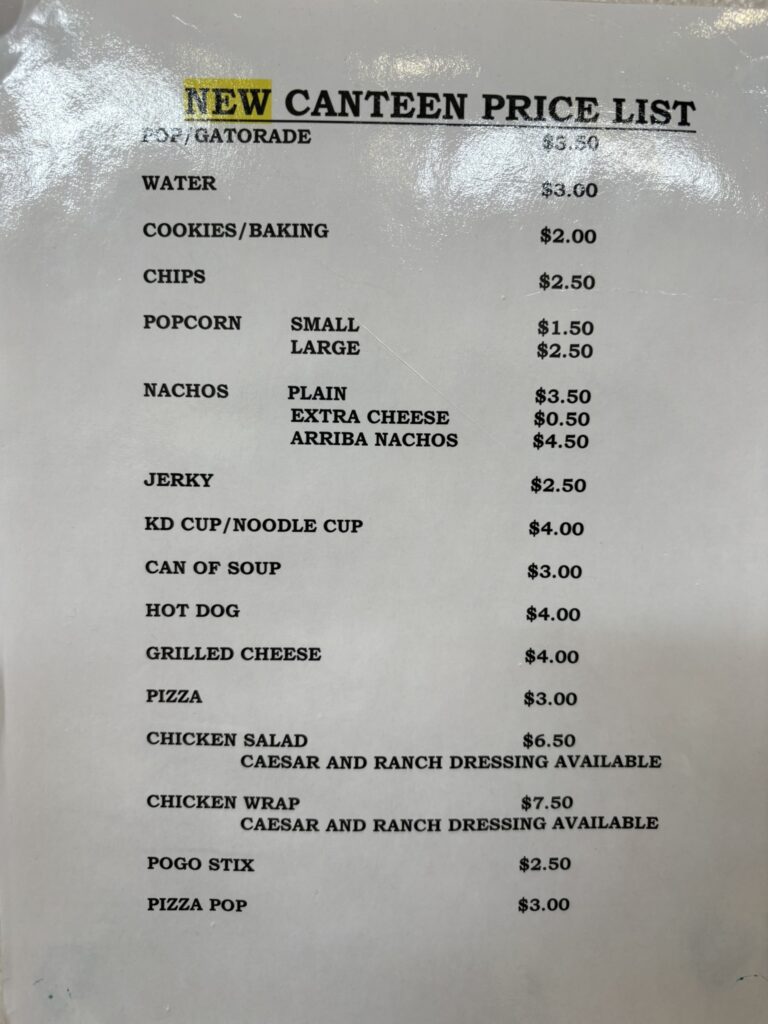
- For lunch, you can bring your own bag lunch (if you need a microwave, these are at a premium in OPHS and it may be a long wait) or you can purchase your lunch at the canteen. It will be open at 11:30 for our group. Each participant will get a $5.00 coupon in the swag bag to put towards any items at the canteen:
- There will not be any computers provided.
Safety Regulations
Chemical Safety
- No containers of toxic or flammable chemicals are allowed.
- Dangerous chemicals are not allowed – this includes prescription drugs and over the counter medication.
- Use substitutes for toxic and corrosive chemicals. Common salt, for example, can be used to simulate chemicals such as ammonium nitrate. Use water instead of alcohol, ether and other highly flammable liquids. Molasses can be used to represent petroleum products. When chemicals are simulated, they should be labelled with the names of the substance they represent preceded by the word “simulated”. No project will be penalized because the key (but potentially dangerous) components were not on display.
Electrical Safety
- Use a voltage as low as possible.
- Use only extension cords in good repair and with CSA approval.
- Cord-connected electrical appliances should have an 8-wire conductor with ground, or be CSA approved.
- Wet cells shall not be used because of the hazardous chemicals involved.
Microorganism Safety and Bio-Hazards
- The following hazardous biological materials may not be displayed:
-Radio-isotopes or compounds containing radio-isotopes at activities above normal background.
-Biological toxins.
-Microorganisms. The use of mixed cultures obtained from the environment (E.g. soils, mouth swabs) are acceptable for experimentation, but not display.
– No cultures are allowed for exhibition. Photographs or simulated cultures may be used.
– Experimentation involving hazardous materials must be carried out under controlled laboratory conditions and supervision. The name and qualifications of the supervisor should be specified.
– Experimental manipulations of recombinant DNA molecules or animal viruses are prohibited.